Beyond the Raised Fists: What the 1968 Olympic Podium Protest Really Said
Tommie Smith, Peter Norman and John Carlos turned the 1968 Olympic 200m podium into a human rights statement. Here is what led to it, what each symbol meant, and what it really cost.
By The Backstory Dept.
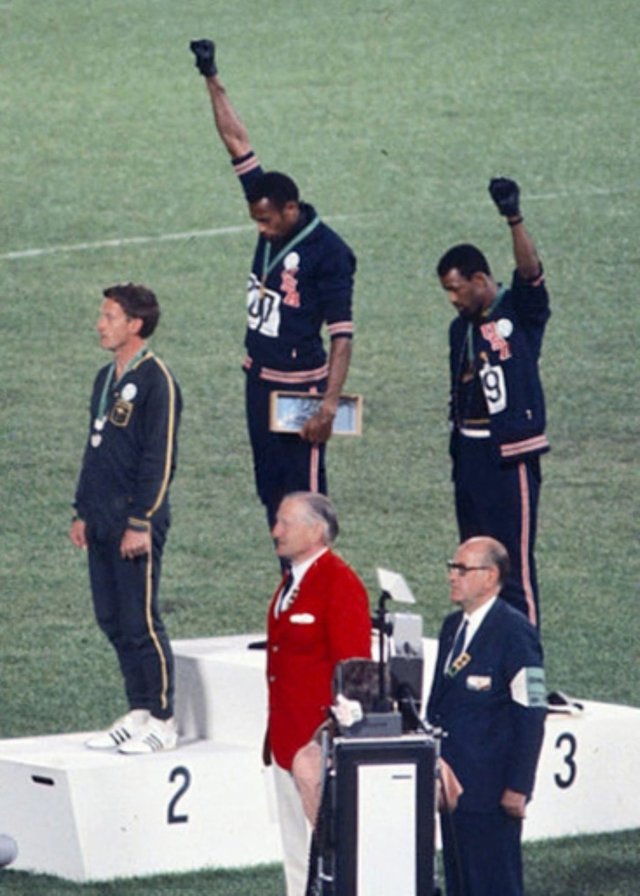
Angelo Cozzi · Original image · Public domain (Public Domain Mark 1.0) License
Everyone knows the picture: two American sprinters on an Olympic podium in Mexico City, heads bowed, each with one black-gloved fist in the air. Fewer people know the race that put them there, the organizing that came before it, or the third man standing a step lower who chose, quietly, to be part of it. The image became a symbol. The protest was a message, and the message was more specific than the symbol usually allows.
On October 16, 1968, Tommie Smith won the men's 200 meters in 19.83 seconds, a world record. Australia's Peter Norman took silver in 20.06, and John Carlos of the United States took bronze in 20.10, according to World Athletics' heritage account of the Games. What happened during the medal ceremony that followed lasted only as long as an anthem. Its consequences lasted decades.
The protest started before the race
The gesture is often remembered as a spontaneous act of defiance. It was not. In the months before Mexico City, Black athletes and organizers had built the Olympic Project for Human Rights, a campaign that used the Olympic stage to draw attention to racial injustice in the United States and beyond. The Smithsonian's National Museum of African American History and Culture, which holds an OPHR button that belonged to Smith, identifies Smith, sociologist Harry Edwards and sprinter Lee Evans among its organizers.
The group seriously discussed a boycott of the Games. In the end, as Smithsonian magazine's account of Smith's own reflections explains, the athletes chose to compete and leave any protest to individual conscience. That decision matters. It means the podium was not the work of a unanimous team, and it was not a stunt invented on the spot. It was a personal choice made inside a larger movement that had already argued about what kind of action would be worth its cost.
Every detail was chosen
Look past the fists and the ceremony becomes a set of deliberate statements. Smith and Carlos climbed the podium without shoes, in black socks, each wearing a single black glove. Smith has described the socks as representing Black poverty, and the bowed heads as a prayer, not a taunt. Both men, and Norman too, wore OPHR badges on their tracksuits.
That framing complicates the shorthand that usually follows the photo. The salute is often filed under Black Power, and the era makes that reading understandable. But the men on the podium tied what they did to human rights, to poverty and to dignity, and they wore the badge of a campaign that used exactly that language. Calling it simply anger misses how carefully it was composed.
The third man on the podium
Peter Norman's place in the story is easy to overlook because his arm stays at his side. Yet World Athletics notes that the Australian wore the OPHR badge on the podium and supported the action. A white sprinter from a country with its own long history of racial exclusion, he made a visible choice to align himself with two competitors whose cause was not obviously his own.
What that choice cost him is harder to state precisely. Norman did not compete at the 1972 Olympics, and many retellings present that absence as direct punishment. The record is more contested than that, and selection disputes rarely have a single cause. What can be said fairly is that his solidarity went largely unrecognized in his lifetime and has been honored far more widely since.
What the Games did, and did not, take away
The reaction was swift. Smith and Carlos were suspended and expelled from the Olympic Village, and they returned to the United States to serious public backlash, according to World Athletics. The Library of Congress, introducing an oral history interview recorded with Carlos for its collections, describes the hostility the protest provoked and the long shadow it cast over his life afterward.
One detail is repeated so often that it has hardened into myth: that the two Americans were stripped of their medals. They were not. Olympedia, the Olympic statistics database, points out that the claim is common and wrong. Smith's gold and Carlos's bronze remained theirs. The penalty was exile from the Games and a long reckoning at home, not an erased result.
From outcasts to honorees
Time has changed the institutional verdict. In 2005, San Jose State University, where Smith and Carlos had studied, unveiled a statue commemorating the podium. World Athletics later honored all three men, Norman included, with its President's Award.
That recognition is real, but it should not smooth over what came first. The same gesture that now earns statues once earned expulsion. Any honest retelling has to hold both facts at once, because the distance between them is the point.
What the headline misses
The famous photograph freezes a few seconds. The fuller story asks readers to see three things it cannot show. First, the protest grew out of organizing that began long before the starting gun, and out of a deliberate choice not to boycott. Second, its symbols were specific: socks for poverty, bowed heads for prayer, badges for a human rights campaign that a white Australian chose to wear too. Third, the punishment was severe but is often misremembered; the medals stayed, while the men paid in other ways.
Fifty-eight years later, debates over athletes and activism still return to that podium, often using the image as shorthand for whatever argument is being made. The men who stood on it left a more precise record than that. Before deciding what the gesture means, it is worth listening to what they said it meant.
Sources
- [1]nmaahc.si.edu
Verified by our desk
- [2]music.si.edu
Verified by our desk
- [3]www.jstor.org
Verified by our desk
- [4]World Athletics: Mexico City 1968 Olympic Games protest, 50th anniversary — World Athletics
Supports: Race date and times; shoeless/black socks/one glove; Norman OPHR badge; Village expulsion and backlash; 2005 SJSU statue.
Verified by our desk · accessed Oct 28, 2026
- [5]Pinback button, Olympic Project for Human Rights, owned by Tommie Smith — Smithsonian NMAAHC
Supports: OPHR organizers Smith, Edwards, Evans; socks as Black poverty. Object image rights not cleared.
Verified by our desk · accessed Oct 28, 2026
- [6]What you don't know about Olympian Tommie Smith's silent gesture — Smithsonian Magazine
Supports: Smith on socks and bowed heads as prayer; boycott discussed, individual protest chosen; OPHR badges.
Verified by our desk · accessed Oct 28, 2026
- [7]1968 Olympic podium salute: Smith, Norman, Carlos President's Award — World Athletics
Supports: Institutional honoring of all three men; race results.
Verified by our desk · accessed Oct 28, 2026
- [8]Memories of an Olympic protest: John Carlos oral history — Library of Congress
Supports: Existence of Carlos oral history; curator description of backlash. Paraphrase only.
Verified by our desk · accessed Oct 28, 2026
- [9]Olympedia: 200 metres, Men, 1968 results — Olympedia
Supports: Official results and times.
Verified by our desk · accessed Oct 28, 2026
- [10]Olympedia: Tommie Smith athlete profile — Olympedia
Supports: Medals were not taken away, despite common claim.
Verified by our desk · accessed Oct 28, 2026