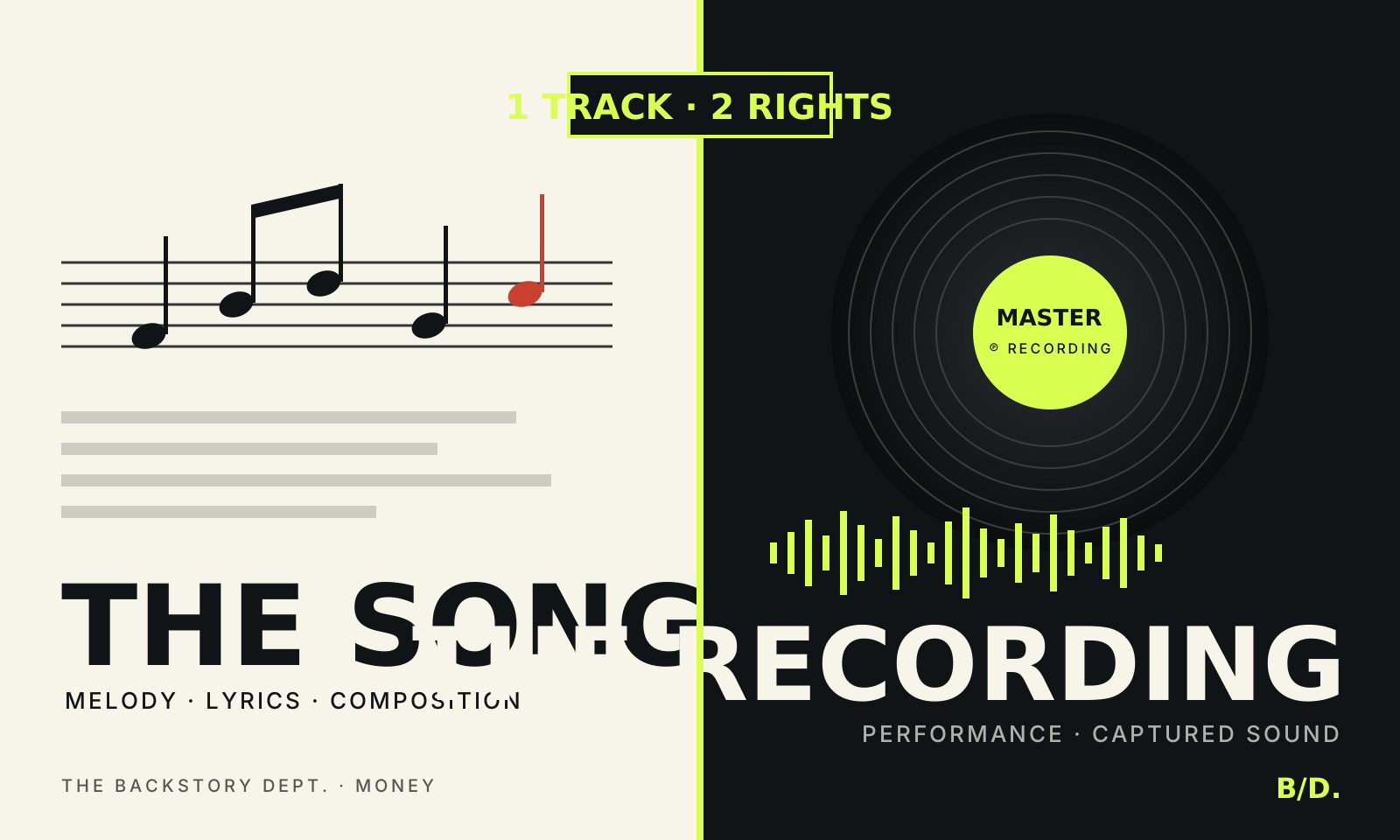
A rapper signs a million-dollar record deal. The headline travels fast. The comments celebrate. Everybody assumes the artist just became a millionaire. But the number on the announcement and the money in the artist’s account can be two very different things.
A label deal can pay for opportunity. It can fund better recordings, a bigger team, promotion and a serious shot at reaching listeners around the world. It can also come with accounting rules that determine when the artist earns another royalty check. To understand the headline, you have to follow the money.
One million dollars. Four very different buckets.
Imagine an entirely hypothetical record deal with a $1,000,000 total commitment. That is the label’s planned investment, not a promise that a million dollars will be deposited into the artist’s personal account. In our example, the package includes a $250,000 cash advance, $300,000 for recording, $300,000 for promotion and $150,000 for video production. Every number below is invented to explain the mechanics, not to represent a standard deal or a real artist.
 View full-size illustration
An illustrative $1 million label commitment. Only one portion is paid directly as the artist's cash advance.
The Backstory Dept. | Original explanatory graphic
That makes the first distinction plain. The artist may receive a $250,000 advance, before any management fees, legal costs or taxes that apply to their situation. The other $750,000 can be paid to studios, production teams, advertising vendors and other people involved in the release. Those expenses might support the artist’s career without ever becoming money the artist can freely spend.
The word to learn is recoupment
An advance is generally an upfront payment against future royalties. In many conventional recording agreements, the label uses the artist’s future master-recording royalty earnings to recover the advance and certain contracted expenses. The Musicians’ Union and United Musicians and Allied Workers both describe this accounting process. Importantly, they also distinguish a recoupable advance from an ordinary loan that the artist must automatically repay out of pocket.
The fine print decides which bills enter that account. Recording costs often do. Video and marketing costs can be treated differently depending on the agreement, and some marketing spending may be a label commitment rather than an artist-recoupable charge. Treating every promotional dollar as an automatic debt would be just as misleading as calling the whole package take-home pay.
Now watch what happens to the royalties
For the second part of our example, imagine the contract treats the $250,000 advance, $300,000 recording budget and $150,000 video budget as recoupable. That creates a $700,000 balance. We are explicitly assuming the $300,000 marketing spend is nonrecoupable in this fictional agreement. A different contract could produce a very different result.
Suppose the recordings eventually generate $2,500,000 in contract-defined master receipts, and the agreement credits the artist with an illustrative 20% royalty on that amount. Twenty percent of $2.5 million is $500,000. That $500,000 reduces the $700,000 recoupable balance to $200,000. Under those simplified assumptions, the artist has not yet reached the point when additional master royalties are payable beyond the advance already received.
 View full-size illustration
The simplified recoupment ledger. These are invented contract terms, not a forecast or a typical royalty rate.
The Backstory Dept. | Original explanatory graphic
The artist could still have received their $250,000 advance earlier. So a later royalty statement showing zero new master royalties does not mean no money ever changed hands. It means the relevant royalty account has not yet earned through its recoupable balance. Nor does this example imply any fixed payout per stream. Streaming income and the contract’s definition of royalty-bearing receipts are much more complicated than a universal cents-per-play formula.
And that is only one income stream
A recording deal concerns income from the master recordings, but a song also has a composition side. Songwriters and publishers may earn mechanical and performance royalties under different rules and agreements. Those streams should not automatically be collapsed into the master royalty ledger in our example. The specific rights, agreements and cross-collateralization provisions matter.
Ownership matters too. What happens to the masters after the deal? How long can the label control the recordings? Are there options for additional projects? Is the artist promised a minimum release or marketing commitment? What can the artist audit or approve? Negotiating those answers can be as important as negotiating the advance itself.
A big deal can still be a good deal
None of this means signing with a label is automatically a mistake. A credible partner can put real capital, distribution and expertise behind music an artist could not otherwise finance at that scale. In 2025, worldwide recorded music revenues reached $31.7 billion, according to IFPI’s March 2026 report, evidence of a large and expanding industry. But industry growth is not the same thing as an individual artist’s financial outcome.
The useful question is not simply, “How much did they sign for?” It is, “How much cash do they receive, which costs are recoupable, which rights are they giving up, and what must happen before the next payment arrives?” A good entertainment lawyer and an independent financial adviser can help an artist get those answers before signing.
The lesson behind the million-dollar headline is simple: a deal amount can buy a career opportunity without becoming the artist’s personal fortune. The contract tells the rest of the story.
Sources
- [1]Record label contracts and getting paid — Musicians' Union
Supports: Advances, royalty payment timing and recoupment of artist advances and recording expenses
Verified by our desk
- [2]Recording contract FAQ — United Musicians and Allied Workers
Supports: Meaning of recoupable advances; marketing commitment distinctions; master and composition royalty differences
Verified by our desk
- [3]The Record Contract: Pay for Play — University of Oregon Open Textbook
Supports: Recording budget, advances, other costs and the recoupment mechanism
Verified by our desk
- [4]Global Music Report 2026 highlights — IFPI
Supports: Global 2025 recorded music revenue of US$31.7 billion
Verified by our desk