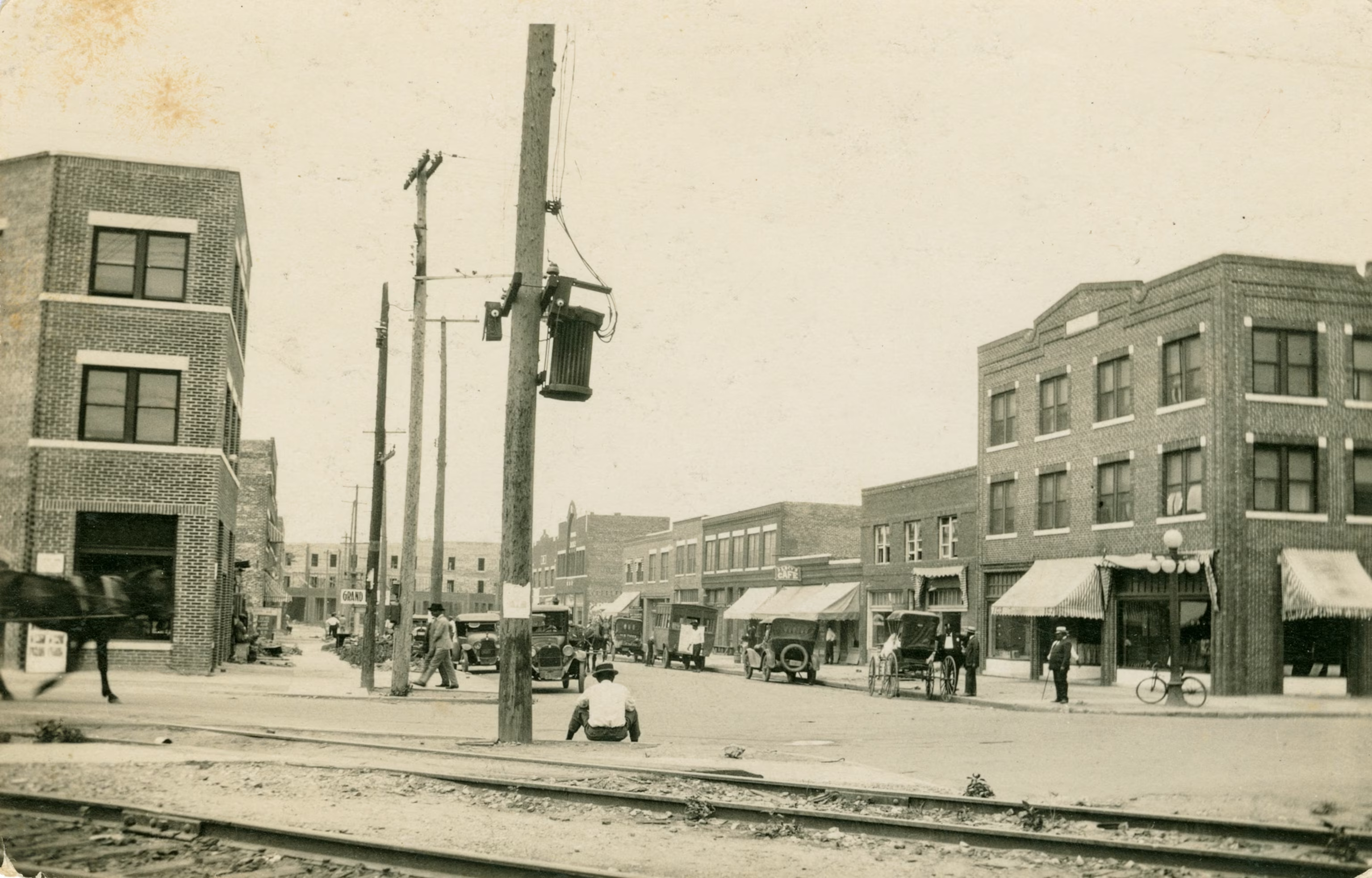
Creator unknown · Original image · Public domain (Public Domain Mark 1.0) License
There is a version of Greenwood's history that ends in smoke. It begins with a prosperous Black district in Tulsa and closes with the massacre that tore through it in 1921. The destruction was real. But ending the story there leaves out the people who went home, rebuilt what they could, fought the city in court and made another life in the place that had been attacked.
Some of the clearest evidence of that second chapter is on film. Between 1948 and 1952, businessman Harold M. Anderson documented everyday life in Greenwood. The Smithsonian's National Museum of American History preserves footage showing a community at work decades after the violence. Anderson himself managed or owned neighborhood movie theaters, a skating rink, a bowling alley and other businesses. Those images offer something the familiar photographs of destruction cannot: a view of Black Wall Street after the fire.
The neighborhood before the flames
Greenwood grew in the early twentieth century in a city shaped by both oil wealth and segregation. Black Tulsans established stores, theaters, professional offices, churches and places to meet along Greenwood Avenue and nearby streets. The district became known for the commercial activity of its Black residents at a time when discrimination closed off opportunities elsewhere. Prosperity did not eliminate the threat around it.
On May 31 and June 1, 1921, white mobs attacked Greenwood, killing Black residents and destroying homes and businesses. The precise death toll remains disputed. The loss was not only financial. Families lost places where their stories, relationships and livelihoods had taken shape.
Rebuilding was a fight, too
The people who survived did not return to a city ready to help them start over. Tulsa officials moved to restrict reconstruction through new building requirements and land-use plans. According to the Smithsonian's guide to the Tulsa Race Massacre oral history collection, attorney B. C. Franklin challenged the city's efforts to prevent residents from rebuilding. Those legal battles mattered because a neighborhood cannot recover if its residents are denied the right to return to their own land.
Recovery was uneven and costly, but it happened. Smithsonian magazine's reporting describes residents rebuilding homes and businesses despite insurance disputes and hostile city policies. A rebuilt Greenwood was not proof that the massacre had somehow been repaired. It was evidence of what residents were determined to preserve in conditions they had not chosen.
The community's newspapers carried that work forward. The Oklahoma Eagle, founded after the massacre, became a place to record Black Tulsa's news and continue a tradition of local reporting. Business owners reopened shops. Churches remained central gathering places. People raised children and built livelihoods in the same district that others had tried to erase.
Look at Greenwood in the 1950s
That mid-century film collection changes the picture. Instead of viewing Greenwood only through ruins, a reader can imagine the ordinary rhythms of a community: the door of a neighborhood theater, customers entering shops, streets where people recognized one another, institutions sustained by residents.
The Smithsonian's collection description follows Anderson's activity as a businessman and filmmaker. It doesn't justify claiming that every household had recovered or that the district returned to its former economic position. A neighborhood can be active, creative and resilient while still carrying losses that cannot be replaced. That is precisely why the footage is important.
Then the map changed again
Another disruption came decades later. During the 1960s and 1970s, road construction and urban renewal projects cut through the rebuilt Greenwood district, displacing additional homes and businesses. The National Museum of African American History and Culture describes how highway construction divided the area and how other redevelopment projects contributed to segregation and economic hardship.
The chronology matters. Greenwood was attacked in 1921. Residents rebuilt across the following decades. Later government decisions changed the physical and economic landscape again. Collapsing these distinct events into one ending conceals both the reconstruction and the choices that made sustaining it more difficult.
The archives keep the story open
Survivors and descendants spent years insisting that the massacre be acknowledged. Their interviews, preserved by the Smithsonian, document not only what happened in 1921 but the long demands for recognition, accountability and repair. Memorial spaces, historical collections and community institutions continue to carry that work.
The John Hope Franklin Reconciliation Park opened in Greenwood in 2010. The Greenwood Cultural Center and the Mabel B. Little House have also helped keep the district's history visible. Each of these places invites a fuller question than whether Black Wall Street survived: who gets to tell its story, and which parts are too often left out?
The massacre deserves to be remembered without softening its violence. The rebuilding deserves to be remembered without asking survivors to make their suffering inspirational. Greenwood's history holds both. The district was attacked, its residents rebuilt, and later policies brought new losses. What endured was not a simple comeback story but a community whose history did not belong to the people who tried to end it.
Sources
- [1]nmaahc.si.edu
Verified by our desk
- [2]americanhistory.si.edu
Verified by our desk
- [3]nmaahc.si.edu
Verified by our desk
- [4]Smithsonian NMAAHC: Remembering Tulsa, Memory and Legacy — National Museum of African American History and Culture
Supports: Highway and urban renewal displacement; institutions and memorials
Verified by our desk
- [5]Smithsonian Archive: Tulsa Massacre Oral History Collection — Smithsonian Institution
Supports: Survivor accounts, B.C. Franklin legal challenge and Greenwood rebuilding
Verified by our desk
- [6]Smithsonian: Greenwood in the Mid-1900s — National Museum of American History
Supports: Harold Anderson footage 1948 to 1952, neighborhood businesses
Verified by our desk
- [7]Smithsonian Magazine: Black Wall Street's Second Destruction — Smithsonian Magazine
Supports: Rebuilding, city policies, and subsequent road construction
Verified by our desk
More from Culture
The Sisters Who Organized Black Louisville Before the Vote
Georgia and Alice Nugent helped turn a Louisville home into a meeting place for Black women's organizing, education and voting rights. Their work expanded far beyond one address.

Louisville early voting starts Oct. 29: Find a location near you
Jefferson County voters can cast a ballot October 29–31 at any designated early voting center. Here's when the sites open, where to start looking and what to check before you go.
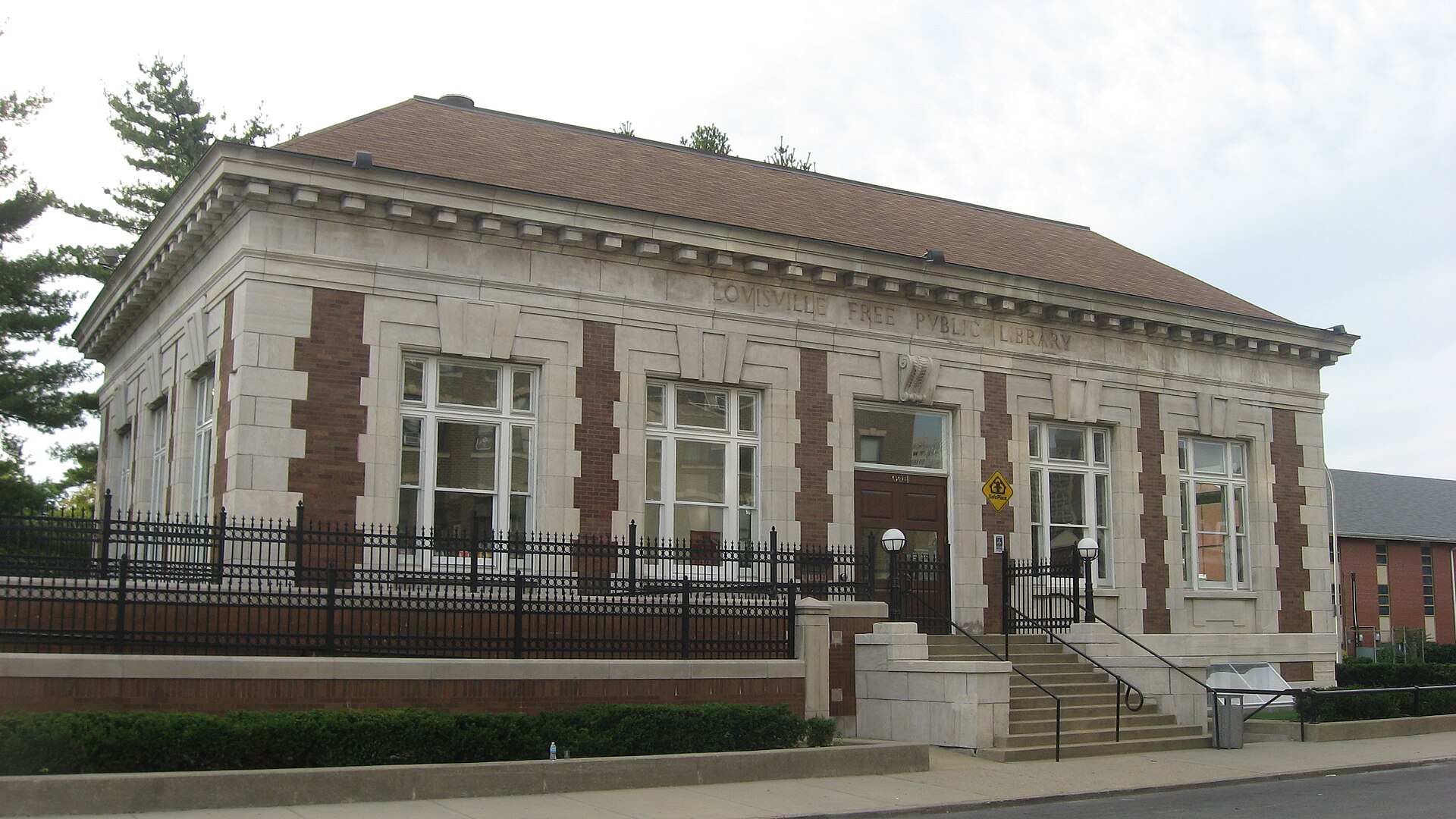
The Library Louisville Built When Its Black Readers Were Shut Out
Before the Carnegie building at Tenth and Chestnut opened in 1908, Black Louisvillians had already fought for, and started, a public library of their own in three rented rooms.