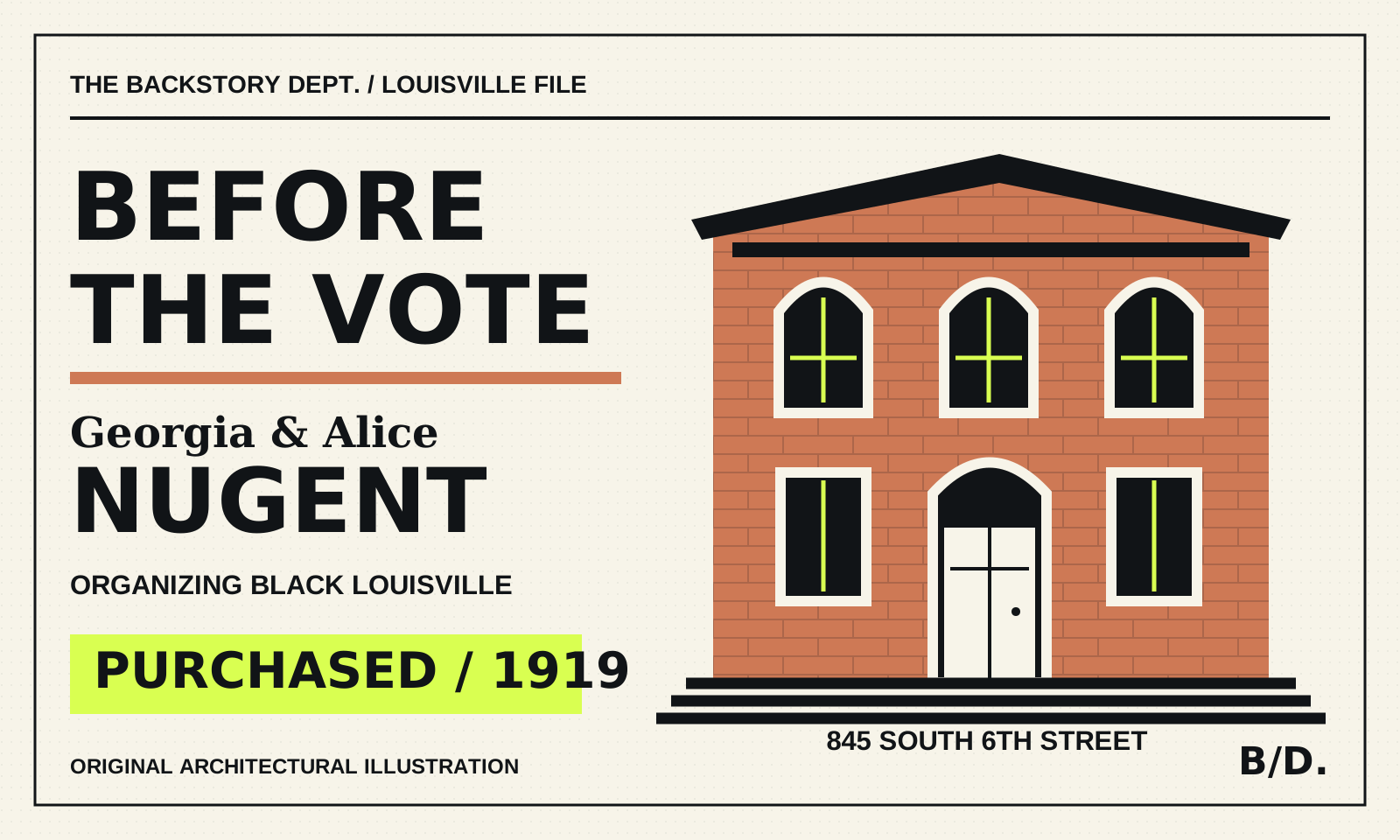
Original illustration · The Backstory Dept.
A house at 845 South Sixth Street in Louisville carries a history bigger than its front door. In 1919, sisters Georgia and Alice Nugent purchased the home. The place became a meeting point for Black women organizing around education, social services and the right to vote. It is now recognized by the National Park Service as an important part of African American women's political history.
The story is not about a single speech or one famous election. It is about organizing that happened long before a national milestone and continued after the laws changed. The Nugent sisters understood that a community needed institutions, relationships and shared work, not only a promise on paper.
A movement before the ballot
Georgia Nugent was a Louisville educator who spent decades teaching in segregated schools. The National Park Service recounts that an 1896 anti-lynching speech by Ida B. Wells in Louisville helped inspire the creation of the Woman's Improvement Club. The club promoted education and health and advocated for Black women's access to voting rights. Georgia served as an early officer and later as president.
Alice Nugent was a teacher and musician who also helped build the club movement. The sisters worked with other activists to establish a statewide organization of Black women's clubs in 1903. Their work extended to educational opportunities and assistance for children, older residents and families living under segregation.
These clubs were not substitutes for political rights. They were ways to build the relationships and organization required to demand those rights. Meetings, correspondence, fundraising and mutual support were all parts of the same long struggle.
A home that made room for organizing
The National Park Service identifies the Nugent House as a gathering place for Black women's clubs and civic advocates. It notes the sisters' involvement with organizations connected to the National Association of Colored Women and the Kentucky Association of Colored Women's Clubs. In a city where Black families often faced barriers to property ownership and public space, a home that could host community organizing had practical importance.
The house was also an ordinary family residence. Relatives and boarders shared the space. That detail helps tell the history accurately: community organizing rarely happened in special buildings alone. It often depended on people opening the places they had and making time outside of paid work.
The vote changed, but the obstacles did not vanish
Kentucky ratified the Nineteenth Amendment on January 6, 1920. When the amendment became part of the Constitution later that year, it prohibited denying the vote on account of sex. Yet racial discrimination, Jim Crow systems and other restrictions continued to prevent many Black women from exercising political power on equal terms. The fight for voting rights could not be separated from the fight against racial exclusion.
Georgia and Alice continued to advocate through civic organizations and education. Georgia's National Park Service biography traces her leadership within Kentucky's Black women's clubs and her involvement in national networks. Alice's biography describes her musical contributions and work with statewide clubs. Their efforts show political organizing as a sustained practice rather than a one-day victory.
Why their address matters today
The Nugent House was added to the National Register of Historic Places in 2020. The National Park Service notes that it is not open to the public. It is a historic place to learn about and respect, not a site where readers should assume they can enter or take a tour.
A city can celebrate progress while overlooking the people who organized to make it possible. Georgia and Alice Nugent are a reminder that voting rights history has neighborhood addresses, teachers, club members and family rooms. Black Louisville's political voice was built by people who kept showing up long before the city was prepared to listen.
The story of the sisters is the story of how local institutions outlast a single campaign. Their organizing connected the household to the neighborhood and the neighborhood to a statewide movement.
Sources
- [1]National Park Service: Nugent House — U.S. National Park Service
Supports: Historic address, 1919 purchase, Black women's suffrage clubs, property status
Verified by our desk
- [2]Georgia Nugent biography — U.S. National Park Service
Supports: 1896 Woman's Improvement Club, career and women's civic organizing
Verified by our desk
- [3]Alice Nugent biography — U.S. National Park Service
Supports: Alice's education, musical and civic contributions
Verified by our desk
- [4]Kentucky and the 19th Amendment — U.S. National Park Service
Supports: Kentucky ratification and women's suffrage context
Verified by our desk
More from Culture

Louisville early voting starts Oct. 29: Find a location near you
Jefferson County voters can cast a ballot October 29–31 at any designated early voting center. Here's when the sites open, where to start looking and what to check before you go.
Black Wall Street Didn't End in 1921: How Greenwood Rebuilt
The Tulsa Race Massacre devastated Greenwood in 1921. Residents rebuilt homes, businesses and institutions before later highway and urban renewal projects reshaped the district again.
The Library Louisville Built When Its Black Readers Were Shut Out
Before the Carnegie building at Tenth and Chestnut opened in 1908, Black Louisvillians had already fought for, and started, a public library of their own in three rented rooms.